If You Can Make It in New York, Part 5: Ferry Ferry, Quite Contrary

One of the reasons I liked riding the Staten Island Ferry is that I was forced to slow down. I tend to be constantly in motion, either mentally or physically, and don’t usually like to slow down, so in a way NYC would seem to be the perfect city for me, but the movement in that city is even too much for me. However, there are times when I’m forced to slow down, such as on an airplane or boat, places I have no control of vehicular movement and can kind of relax. If I weren’t forced to slow down by circumstances, I would probably just keep moving and not even think about it. It might seem a bit contradictory, but although I hate to slow down, I sometimes appreciate being forced to slow down. So the ferry ride was enjoyable, as I could actually sit and talk to other people who couldn’t rush elsewhere either.

On the ferry, I met a guy who had served in war and was too jaded by what he had witnessed and didn’t want to talk very long. I also met a guy with broken English, so I really don’t know if we understood each other very much, but I got wrapped up in conversation with him. Before I knew it, the ride was over, and our group then went back around in order to ride the ferry the other way. For those who don’t know, pretty much what the ferry does is carry passengers back and forth across water between Manhattan and Staten Island, and as they travel, they are able to see the Statue of Liberty from afar. On our first trip across, I had not even seen the Statue of Liberty, so on the way back, I made sure to sit in the outer area of the deck I was on, just so I would have an opportunity to see her. During our return trip, I met one of the firefighters who had helped with cleaning up Ground Zero. He believes there’s got to be someone out there, but he wasn’t open to hearing what I had to say.

I thought she'd be a lot taller.
I thought she’d be a lot taller.

Although I might not have had anyone hear me out, the slow pace of the ferry was a contrast to the hustle and bustle that NYC is known for. Because of the slowness and calmness of the travel it allowed for opportunity to talk with people one-on-one, even if for a short time. There was no rushing by any of the travelers to get to the next destination; it was an atmosphere much like the park from that previous Sunday.

After we had regrouped and left the ferry, we were soon led to the site now known as Ground Zero, a reminder of a life and country that were much different almost fifteen years ago. Before we got to our destination, Sam told us how he had been impacted by that tragic day and its aftermath, having been doing what he does for years in NYC before all events of that day had transpired. He had lost people himself, but through this tragedy, he had gained a new perspective on what he does. Then it was time to go there and see firsthand how things currently look.
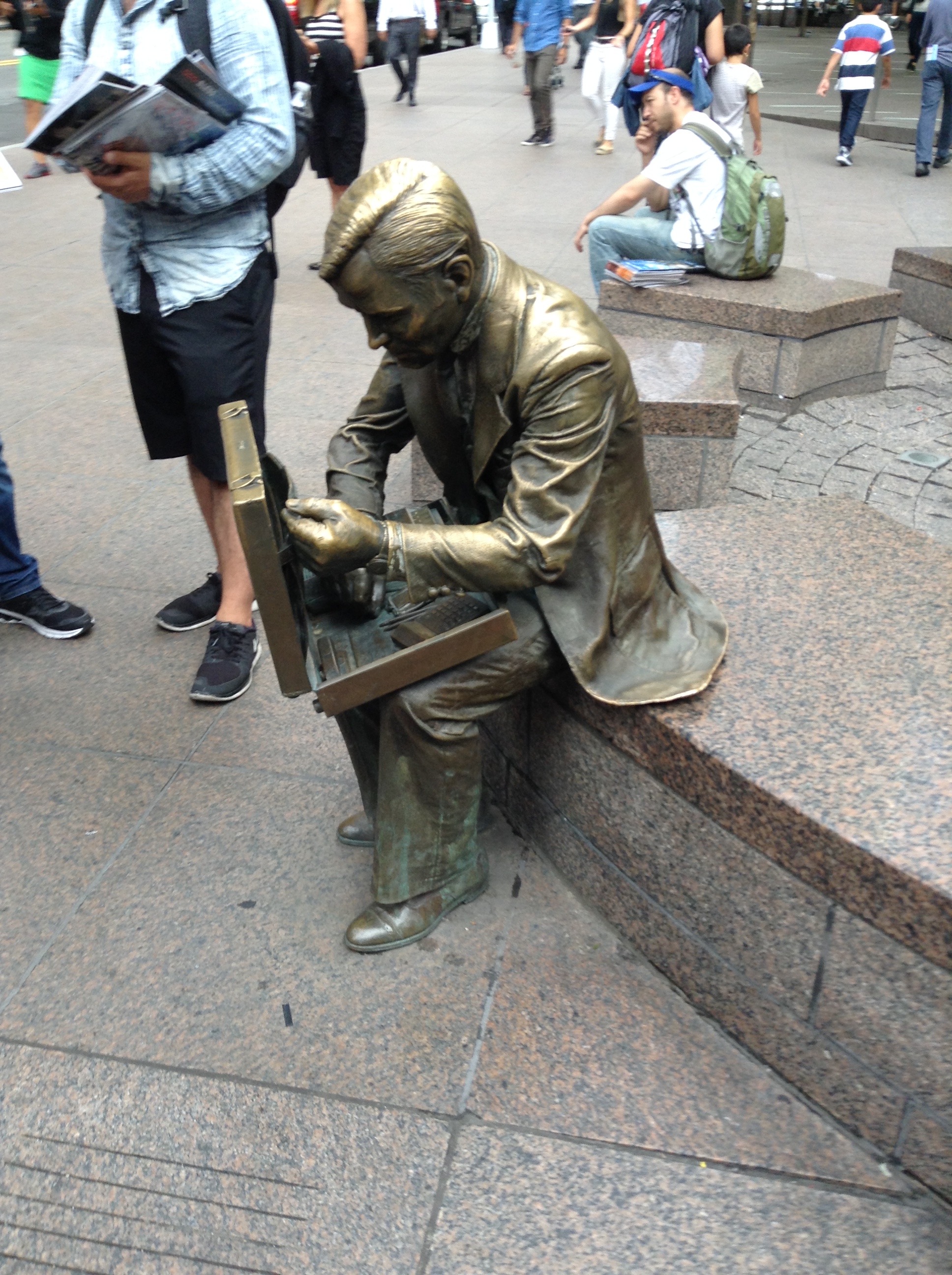
Statue near Ground Zero

Ground Zero has a paid museum, as well as a couple reflecting pool, which are free to visitors outside; at least, I think they’re reflecting pools. (They look like fountains with water constantly flowing down to I don’t know where). Engraved into the barrier along the perimeter of the fountains are names of people lost that day. The World Trade Center, once a center of business and commerce, has become a memorial ground for lives cut short. It goes to show that in the end, it’s still people who matter more than things. I can’t really describe how I felt being in that location, as I wasn’t directly affected by that day, but I have since come to know people who were.

After spending some time at Ground Zero, we eventually went to dinner in Chinatown (or Little Italy for others). In some ways it’s not much different from other places, since it has some of the same businesses, but it also has its own Chinese culture. We didn’t spend a lot of time exploring it, so I don’t know what all is there, but that’s New York: little time, lots to see and do.

It was a somewhat long day, and tomorrow would be our last full day of work, and who knew what that day would bring.
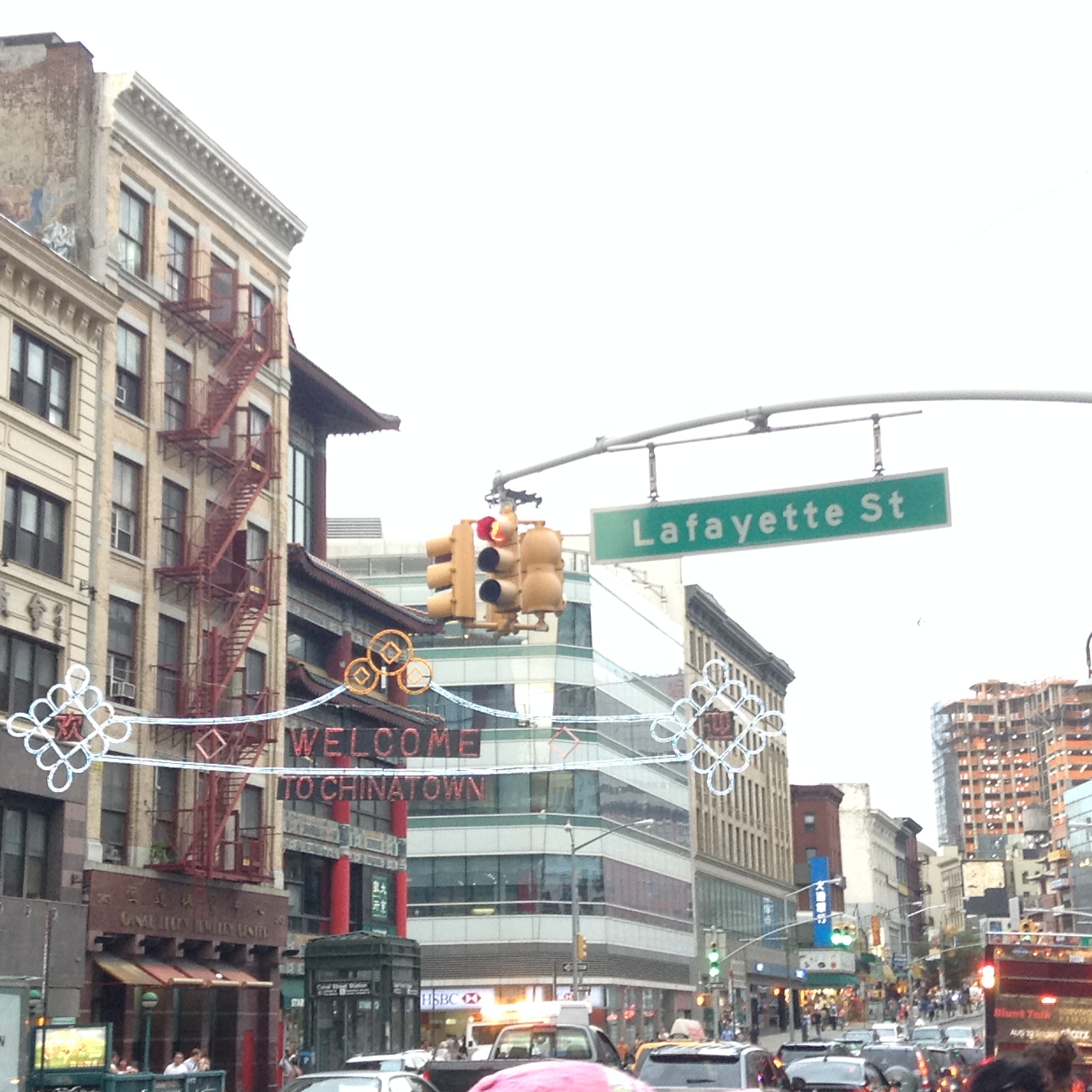
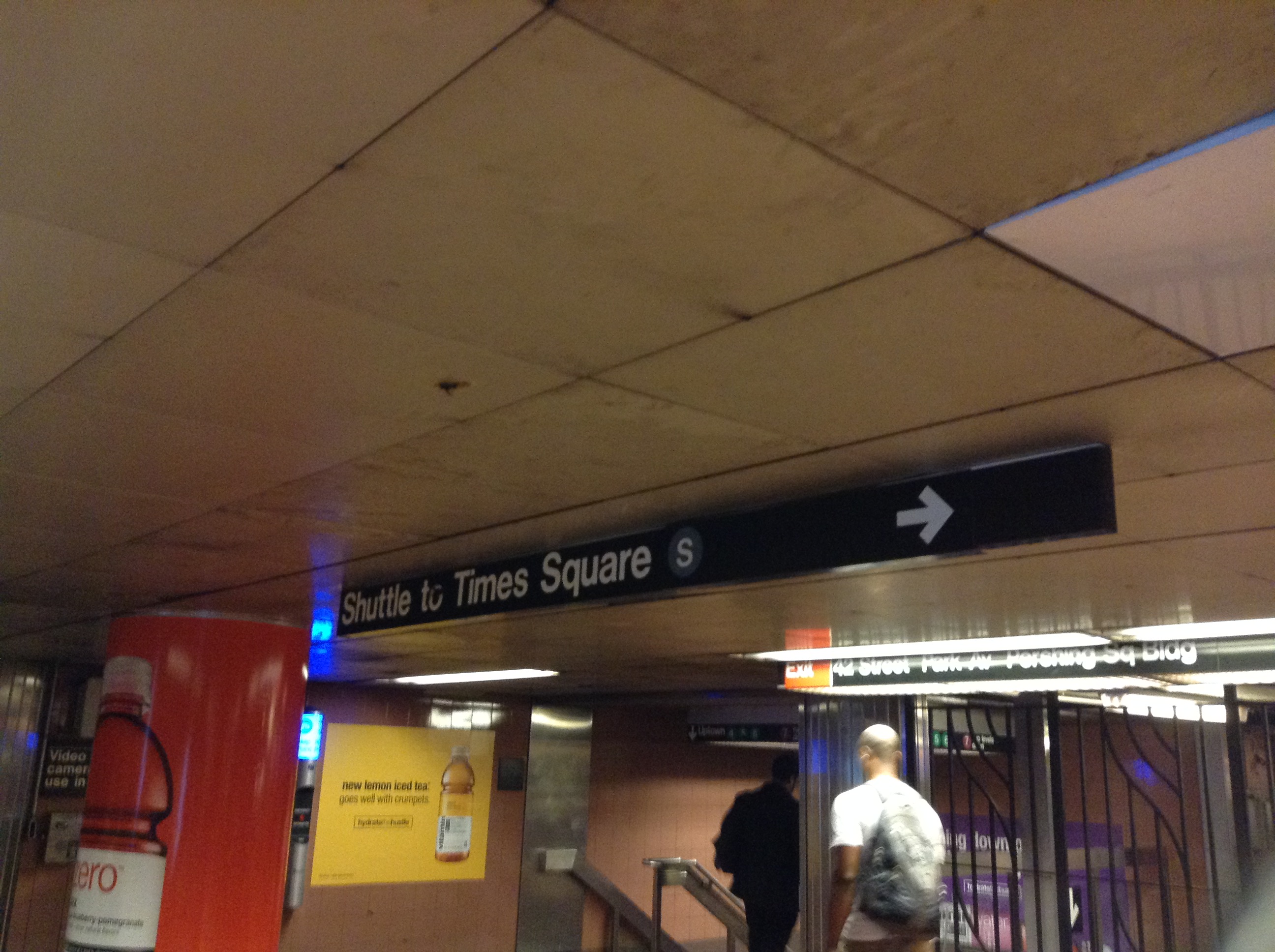
Chinatown

If You Can Make It in New York, Part 4: NYC Is A Microcosm of the USA

The first day was hard to talk to people because I was new to the area, and the second because people in New York City don’t seem to stop moving. Tuesday started out with even more difficulty. I should mention that I have a somewhat heightened sense of hearing, and we spent part of the morning talking to people beneath an overhead subway terminal. If you’ve ever tried talking to people above the noise of trains passing overhead, you would understand my experience. That is, if they’ll even pay attention to you. But that was just the morning.

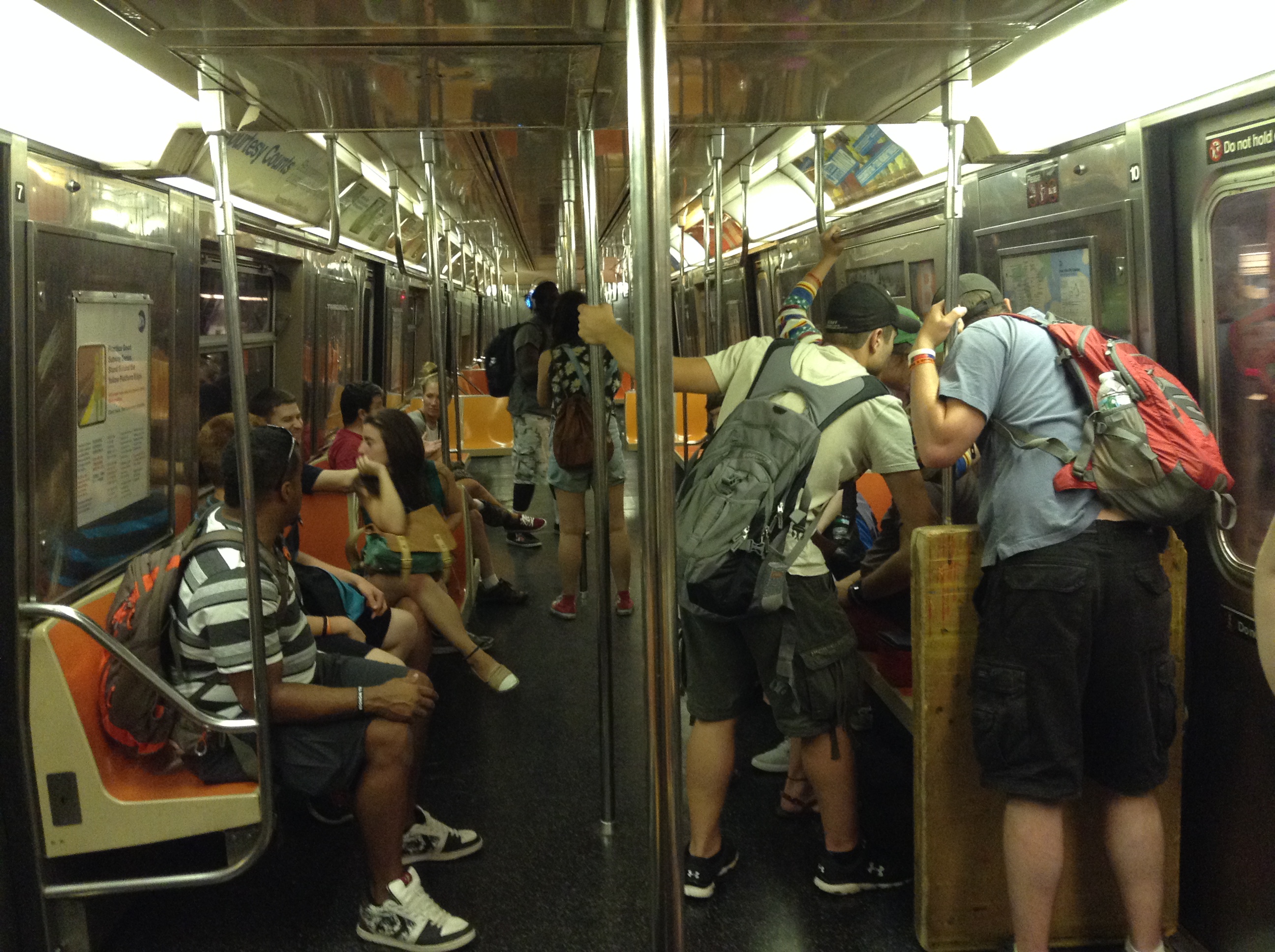
The forecast for Tuesday called for rain all day, so the plan was to stick with the subways and later ride the Staten Island Ferry. As if talking with subways running overhead wasn’t difficult enough, trying to talk while they were constantly coming and going around me was nearly impossible. Each day seemed to add a new layer of noise as a barrier I could not overcome; I felt so useless trying to talk with anyone when I couldn’t even hear myself, plus the fact that trains arrived so often, which quickly cut off most encounters. I think I had one good conversation going before the guy I was talking with had to go.

After being in NYC for about a day or so, what I felt in the subway terminal at one point is probably best described as discouragement or defeat. If I must be honest, there were times during the trip I felt a bit disconnected from everyone else with me, and it was those times I felt the most vulnerable. Besides heightened hearing, another thing about me is that I spend a lot of time being introspective, and it sometimes creates a sense of isolation, no matter how many other people are around me. I’ve really only become social within the past six years or so, but whenever I am not actively talking with anyone else, finding a conversation to join, or noticing the noise level, I tend to become introspective. This trip was no different; if I wasn’t talking to a stranger or someone I was traveling with, I sometimes became very introspective.

I felt so discouraged because I saw many people rushing around, few having time to stop and talk or even willing to accept a tract as they passed by. People are so rushed in this city that never stops moving, and they don’t seem to have time for God. Not only do people not have time for God, but as I also noticed on subways and other areas, people put on headphones or bury themselves in reading material or some electronic device, so they don’t necessarily have to acknowledge others around them between where they were and where they’re going. Since I’ve seen this back home and other places outside New York as well, it occurred to me that New York City is just a small version of the country as a whole; we have such an individualistic culture and individualized distractions that it’s easy to tune out whatever we want. We’re too busy for God and too self-absorbed for other people. I can’t say I don’t do this myself. I currently live by myself, so I know what it’s like to feel isolated or lonely, and not always by choice, but sometimes I think we bring those feelings on ourselves by our actions or inactions.

While the subway and its busyness felt discouraging, the Staten Island Ferry we would be on later that afternoon was one of the times I enjoyed during the whole week.

Times Square

If You Can Make It in New York, Part 3: It’s A Long Story, Just Get the Firehose

The following day (Monday), we went to a different area of the city; whereas previously we had gone to a park in which people were mostly sitting around and relaxing, that second day was a hustle-and-bustle kind of day along the sidewalks elsewhere. People were constantly moving, so I felt even less able to engage anyone in conversation, but I did finally manage to talk to a few people that day. Sadly, not all of the conversations went well; in fact, one of them was a bit intense.

This particular conversation I had was with a guy whom I simply thought might have overheard what members of my team had been talking about with someone else. Unfortunately, after talking with him shortly, I found his view on the Bible so distorted and awkward that I didn’t know what to make of what he was saying; he knew certain verses but somehow was way off their context or even what they said directly. I wouldn’t say he was crazy, but he was severely misguided in his interpretation and somewhat abrasive in his speech; in fact, I afterwards found out he belonged to a cult I’d never heard of before. Jeff was able to get me out of the conversation, and we walked a little bit down the street, but then this guy walked up and started to talking to me again, until Sam engaged him in conversation, and we were able to move on. I think I was still reeling from that experience for a while; it kind of stuck with me throughout the week. In hindsight, some of what he had said was a bit laughable (not necessarily in a good way though) because of how he used the verses compared with the correct interpretation. But I digress; however, I became a little more cautious about approaching people on the street after that experience.

Another conversation I had that day just kind of went in circles, with the guy I talked to saying he had moved beyond the Bible and saw all religions as having pieces of truth. The conversation might not have gone anywhere, but at least he was a nice person to talk to.

As we were nearing the end of our time in the area, as I was waiting with one of my teammates, a lady walked over to us and asked for prayer for a specific issue. I had noticed her previously during our time there, but she had been working at one of the stores, so I never approached her. She wasn’t a believer, but it was still encouraging that she had come over and asked for prayer. Since she was still supposed to be working, I had a brief time to talk but was able to share the Gospel with her and pray for her request.

We headed to dinner that evening around Union Square, but before we arrived there, we had gone to the underground part that shows names of those lost on September 11, 2001. I can’t say what I ate tasted great (I think I’ll avoid goat cheese), but I did get to have a brief religious discussion with the guy I bought my dinner from. He was friendly, but he disagreed with some of what I had to share.

Names of people lost on 9-11

After dinner, it was back to work; this time we got to see the paint presentation and tried talking to people that way. The paint presentation is a way that someone explains the Gospel while painting what s/he is talking about; it’s very interesting to watch someone drawing a picture while sharing a message. We then try to engage with whomever may have been listening/watching this, or conversely, try to talk with those who are walking by/away midway through the presentation.

Later on, it was time to head back to the church, and that’s when we got lost in New York City (we did have a guy named Kevin with us). Let me just explain what Sam had told us from the get-go; if he wasn’t with us, we were lost, because he knew the city. Whether we were on the subway train and he wasn’t or vice versa, we were lost. Not all of us made it to the train we were supposed to get on, but those of us who did were “lost.” Those few minutes without Sam were pretty exciting and somewhat hilarious. Not every day would be this eventful or chaotic, but some things did just seem to get more difficult with each day that passed.

nosam

If You Can Make It in New York, Part 2: The First Step Is Almost Always the Hardest

Go therefore and make disciples of all the nations, baptizing them in the name of the Father and the Son and the Holy Spirit, teaching them to observe all that I commanded you; and lo, I am with you always, even to the end of the age. -Matthew 28:19-20 NASB

IMG_3265

Our first afternoon in New York City, we took the subway to Bryant Park. (Without looking it up, I could not tell you at all what part of NYC that is; we took the subway all over, so I have no idea what is where or how to get there.) It was our first day, but already we were supposed to go talk to strangers about the Gospel. Incidentally, this was a first for many of us, whether it be this type of trip or even going to New York. I don’t know what is it about talking to other people that can be so nerve-wracking, more specifically when it comes to matters of faith, and even more so when you know what you believe is truth others need to hear. But anyway, in order to accomplish our objective, we had been split into teams of four: three of us Texans plus a student/intern from Word of Life, the organization we were working with that week; my team leader was Jeff. So there we were in Bryant Park with the intent of talking to people we had never met before, and after a brief team huddle and prayer, we were off to spread the message.

Honestly, I’ve never really been good at walking up to people and starting small talk. I’m an introvert, and it’s taken me years to get to a point in my life in which talking to people is somewhat enjoyable, but starting a conversation can still be a challenge for me, especially with people I don’t know. Being thrown into this the first day of my arrival did not really make it easier on me. I’d rather have just handed out tracts than talked to people; that would’ve been a lot easier (maybe more cowardly). The first guy I remember talking with had a somewhat thick Spanish accent; he was from Mexico and had recently lost a loved one. I think he was a believer, but I can’t be sure because I had trouble understanding him during our conversation. I do know he had needed someone to talk to about what was going on with him, so I was able to minister to him in that way, even if I couldn’t always figure out what he was saying. Another conversation I had was with a young woman who was respectful of what I had to say, even if she didn’t agree with me. I talked with a guy until he got distracted by a phone call; he had told me that if humans can figure out how to get along, then we can figure out what’s out there (or something to that effect). I also met a man who was a believer; he seemed so negative with how some Christians go about sharing their faith, but we had a nice short theological discussion before it was time to leave for the day. Needless to say, I still wasn’t sure what I was doing, and I felt a bit discouraged with the whole experience that day.

I didn’t think things had really gone that great, but if all we were going to do was walk up to people sitting there and start talking to them, maybe things wouldn’t be so bad. Ha, I was still getting my feet proverbially wet, but was I in for a rude awakening the following day.

If You Can Make It in New York, Part 1: Getting There Is Just the Beginning

It is the best of cities; it is the worst of cities. If I may borrow from Charles Dickens just a bit in order to describe New York City.

Recently I had a chance to visit New York City for the first time ever. I was there with some people from my church, and our reason for going was to do what is known as “open air evangelism” or “street evangelism.” It’s pretty much walking up to complete strangers and telling them about Jesus Christ, allowing them an opportunity to place their trust in Him. At least that’s the point of it. Somehow over the centuries, we’ve made it so difficult on ourselves to do something that should be so simple, but we were determined to do this.

Now that you know why we were there, let me back up several months to briefly explain how this came about. Ever since last year, the church I go to (Woodcreek in Richardson, Tx) has been doing something called “Everybody Matters.” Why? Because they do. Humans made in the image of God matter to Him, so they should matter to us. Because everyone matters, we should be reaching out to them. Not far removed this overarching theme/objective, our young adults community was exploring what that meant to us as, well, young adults in North Texas. Towards the end of last year and the beginning of this year, we were given lessons (for lack of a better word) on how to share the Gospel with various groups of people. This culminated with the idea to take what we were trying to do beyond our little bubble of life into somewhere else, and a missions trip was born; without going into a lot of details, NYC became the destination.

This idea was presented to us, and it was opened to anyone interested in taking the Gospel of Jesus Christ to NYC; it had started with young adults but soon grew to include anyone within the church. From the moment I heard this announcement, I was on board. It wasn’t because I had everything figured out or knew what to expect. Quite the contrary; frankly, I had no idea what to expect. Something you should know about me is I like trying new things and sometimes going to new places. I’d been on a couple missions trips prior, but those times the objective was different, though related; I’d also never been to New York (almost did in 2010). So this was perfect for me, and I was gung-ho to go.

As the months passed, my eagerness ebbed and flowed; life has a way of doing that to our excitement for future events. And then came the event. I don’t know that I was ever fully prepared for this trip, as I didn’t necessarily have any pre-conceived expectations, and when I got there, I was never fully taken in by the sights (as in “this is the most awesome place I’ve ever been”). Don’t get me wrong, there’s something about New York City that kind of draws you in, but at the same time, maybe there’s this sort of disconnect I can’t explain. Or maybe it was just me; after all, I was in a new place with people I’d somewhat gotten to know before this trip. We all were there for the same purpose, yet there were times when it was basically just me with my thoughts in a city I didn’t know.

We arrived on a Sunday afternoon at the church we would be staying during the week. The church we stayed at has multiple services in different languages on any given Sunday, which means the building was not ready for temporary habitation when we arrived, so what did we do in the meantime? Our leader Sam liked to say, “the best way to kill time is to work it to death.” So he had us go do what we came to do, but I’m pretty sure none of us were prepared for that just yet. I think we were expecting to get to work the following day after getting our bearings and such, but that first day we got right to work. And that is where this story really begins.

teamstart

Insociable Media

In the age of social media,
Our convictions are certain
It doesn’t matter what happened
Or who may be hurtin’

We can honor people
Who do nothing great
Or quickly crucify those
Who make a mistake.

Circumstances don’t matter
We’re so quick to judge
We don’t need all the facts
Video alone is proof enough

We’re judges and juries
We know exactly why
That thing happened.
Our views cannot be denied

Responsibility
No one wants to take it
Everyone else’s fault
That’s why we can’t make it

Hate is all around us
The Internet just made it faster
Alert everyone you know
About each human disaster!

People are jaded and cynical
It’s so commonplace
We point out others’ failures
And leave no room for grace

It’s easy to condemn
Where you’ve never been
And pass on blame
To whomever you shame

There are wrongs in this world
That much is true
But when quick to judge,
What if it were you?

Wanna Know What I Do For A Living?

Most people who know me don’t really know what my job is, unless I work or worked with them, so the simple answer I always give when people ask is “data entry and check processing.” (Sounds super exciting, huh?) But the more complicated answer is that I don’t really know how to explain it to people who don’t already know what I do.

1. I’m not always good at explaining things, even if I do understand them myself.

I can extrapolate information and solve problems; just don’t ask me to explain what I know or how I figured it out. (Even if I explain something innumerable times, people still don’t get it.)

2. I work with somewhat confidential information and don’t want to reveal anything I’m not supposed to.

That can make it difficult to tell people if/when I do see something interesting/funny that pertains to the work itself.

3. There are details so specific to what I do that I didn’t know about them until I was where I am.

Sure I could probably try to go into some of those specifics, but you’d really have to want to know. Otherwise, I might bore or confuse you with details (see #1). Besides, when my friend who helped get me this job explained what he did, I imagined it so much different than reality, and I don’t think he necessarily explained it poorly.

4. We’re not open to the public.

Dealing with the public may not always be great, but many places you can go into and see exactly what people do there; nobody has to tell you what is supposed to happen. I don’t work in one of those places. In fact, whatever I work with stays on site, and I almost never have any sort of direct dealings with any of our clients or their representatives (only if someone is touring the facility during my shift). If I’m not producing anything specific and no one really interacts with me from the outside world, I don’t really have anything to show as an example of what I do.

5. Sometimes I’m not really sure what I do myself.

Of course I know what I do directly and on a daily basis, but if I wanted to take a step back and look at any sort of big picture, I would have no idea what I was looking at or for. I’ve also been where I am long enough to have developed some sort of skills, but I’m not even sure how to quantify whatever skills I may have developed during my time there. (I am working on a “What have I learned?” list, but that’s for another time and is not exactly skill-based.)

So many times I hear people talk about their jobs, and I understand what they do. I may not want to do what they do or fully understand all the details of what goes on, but at least I can have somewhat of a grasp. My job is not one of those jobs, but I don’t really know how to explain what I do either, other than “data entry and check processing.”

ABC’s of Worry

As you
Become more like
Christ, your
Development should become more
Evident in your life.
Faithfully you’ll begin to let
God control everything, as
He is supposed to.

If you
Just
Keep
Letting him do
Mighty works in you, there’s
No telling what can
Occur in your life.

Perhaps you’ll
Quit worrying about things that don’t matter,
Remembering there’s a plan for your life, even when things
Spiral seemingly out of control.

Trust is so important to
Understanding the
Very nature of all God has in store, but if you just
Worry, you’ll miss everything around you and only
Xhaust
Yourself, making it hard to catch some
Z’s.

Why Are People Afraid of Change?

Why do people hate change? Because humans are scared, selfish creatures by nature, but the truth is we don’t really hate change. Yet something about change really bothers us. Okay, let me go back to the beginning to start over.

The Bible and creation tells us that God’s glory is the grand purpose of our existence. We exist to glorify Him, but something changed in the fall when sin entered the picture. A long time ago, Adam and Eve lived in harmony with God the Creator, but then the man and woman ate fruit that God had told them not to eat, and suddenly that harmony was broken. Humans became afraid and selfish. They played the Blame Game Family Edition (patent pending), then God kicked them out of paradise, but they and their offspring (that’s us) remained selfish. Change happened anyway.

Fast forward to what this has to do with anything.

The church I am a part of has been going through transition, as it is currently going through a somewhat major leadership change after having lost another crucial leader recently. Part of the change affects me directly. Part of me is happy; part of me is sad. Frankly, I’m not always fond of change, but change is nothing new to me. People come, people go. Leaders come, leaders go. That’s just life, and we can choose to accept and adapt or sit in a corner and pout about life not going the way we think it should. While nobody is exactly leaving for this next phase of transition, it’s still a major change, since our young adults pastor Jon is moving to a different role and Kevin our college director will be moving into Jon’s role. I’ve known these guys in their respective roles since I met them nearly two years ago. Because this is somewhat of a big deal, someone might ask the question “why are people so afraid of change?” A valid question perhaps, and one I’ve been kind of pondering since learning of news of this transition and hearing what Jon and Kevin each had to say in regards to this role change and even touching on this question. In fact, they each said something that strikes at the very heart of the question.

So what if I told you we as humans aren’t scared of change itself, but we’re actually scared of what it represents? Change happens every day, but nobody notices or cares. You change your clothes (I hope). You change lanes while driving. You change positions: sit down, lie down, and stand up (good boy). You change the channel because you get bored of or disagree with whatever is on Internet-o-vision. Without really thinking about it, we as humans make subtle changes, but changes nonetheless, on a regular basis. Yet when major change happens, it can rock our world. It can make us, break us, or just simply shake us. But why? What is so scary about major changes when minor changes don’t seem to phase us whatsoever?

When major changes happen, it reminds us of this one simple truth we often like to forget. We are not actually in control of what’s going on around us; we are not in control of this massive thing called the universe or even life itself. Little changes don’t scare us, because we have a sense of control, and we know how some of our mostly-innocuous decisions will or won’t affect us or maybe even people around us. Don’t eat, and you go hungry; decide to eat, and you won’t. Go to work, get paid. Simple, right? But when a huge, potentially life-altering decision comes up, we fear the unknown and suddenly catch a case of “what-if-itis.” What if this? What if that? “What if people don’t like me? What if they think I’m boring? What if she rejects me? Will anyone remember me when I’m gone? What if I lose my job and can’t provide for my family anymore? What if it’s terminal? What if the world inexplicably implodes because I move to Canada to run a bird sanctuary? What if my baby could’ve grown up to be a time-traveling rocket scientist but instead ends up in prison for embezzling money all because I didn’t take that lucrative job offer in order to pay top dollar for her primary education?” Maybe a bit extreme, but we can conjure up any sort of “what if?” when we’re afraid (or just imaginative) and realize that we in fact don’t control outcomes the way we may have convinced ourselves we do.

In addressing this issue of fear earlier this week, Jon reminded us that through this transition and any change really, God is in control, and everything is going to be okay regardless of the outcome. Yes, this is a major change, and as he pointed out, we don’t know how it will play out next year, the year after, or even ten years down the road, but we don’t have to. We and our finite understanding and frail humanity are not in control, but an omniscient, omnipresent, omnipotent, loving God is in charge of this universe, and that’s a good thing. You know why? Because not only are we afraid of the unknown, but we the human race are inherently selfish. And that’s a bad thing.

Change makes us afraid because it reminds us we’re not in control, but it can also be a wake-up call to tell us something equally important. The universe we do not control does not revolve around us either, but we don’t like to be reminded that we’re not the center of reality. When something good happens, it’s easy to think how wonderful I must be to earn God’s favor, and when bad strikes, it’s just as easy to wonder what I did to deserve this. Why would anyone think like this? Because we’re selfish. I’m selfish. You’re selfish. We the offspring of Adam and Eve are selfish creatures.

Going back to the transition, this selfishness is something that Kevin touched on in talking about his role in ministry; he said that there are times he’s ready to go serve others, and other times he’s not. I’m sure it’s true for any one of us who is honest enough to admit it, even if we do like to help others. This selfishness is the part of me that says, “Jon has been my leader since I came to this church, so I don’t want him to go somewhere else, even if it just to a different role in a different room around the corner. I don’t care about your happiness or if this change could make things better; I’m comfortable, and that’s what matters most.” Don’t misunderstand what I’m saying. I have no doubt Kevin will do great in his new leadership role, and I’m happy he’s shouldering this responsibility, so my point is not that I wouldn’t want to follow him because he’s not Jon. In fact, I will stand by and support Kevin in his new role (except when I’m feeling selfish of course). At the same time, I have enjoyed people being where they are and would’ve kept it that way, but that’s because I’m selfish. When change doesn’t happen, it can be so easy to get comfortable or even complacent and forget that this life is not even about me. As change happens, my selfish desire to keep things as they have been is something I have to move past; besides, I’ve made changes in my own life because I didn’t like how things were.

So why do people hate change? They don’t, yet they do. The answer is a lot simpler than people are afraid of change. The reality is they just don’t like to be reminded that they’re not ultimately in control and that life doesn’t revolve around them. But if we aren’t willing to accept change, we will never grow.

Life is full of change. Change is inevitable. The only constant is change.

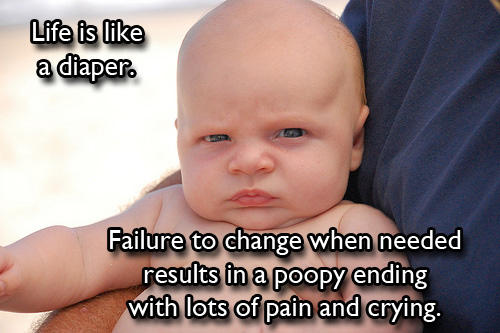
Growth is change. Stagnation is the anti-change, which leads to death. That too is a change.life diaper